


Message from the Directorを更新しました(Jan 1,2025)。
Exploring the History of Medicine, Part 51: Florence, Part 31

Tiber Island
In the Tiber River that flows through the city of Rome, there is only one island in the middle of the river, known as Tiber Island.
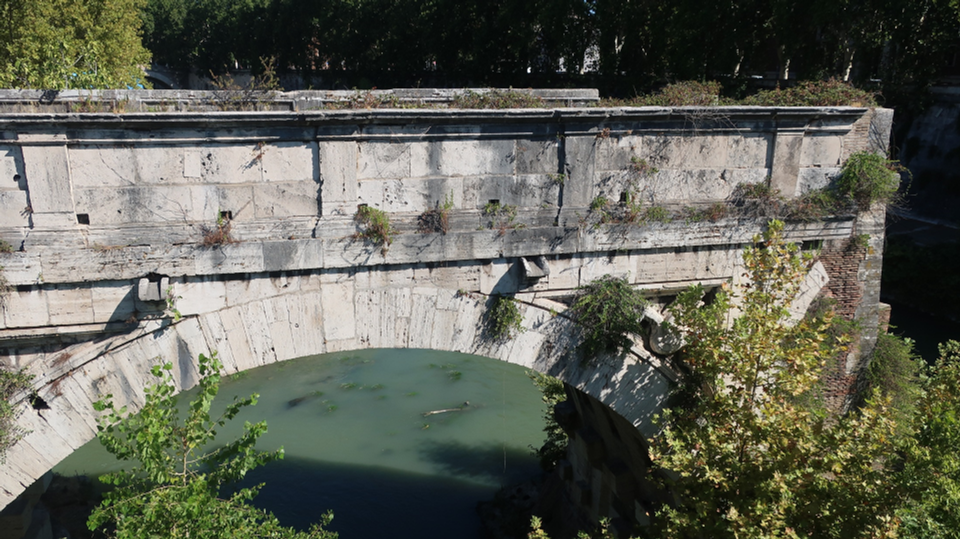
On the eastern side of the island stands the Pons Fabricius (1st century BC), which is the second oldest surviving bridge in Rome after the Milvian Bridge (2nd century BC).
It has remained largely intact without major restoration and is still in use today.
I myself had the opportunity to walk across it.
On the southern side of the island, in the river, there are also the remains of the oldest stone bridge from ancient Rome (2nd century BC).
It was originally called the Pons Aemilius, but today it is known as the “Ponte Rotto” (the Broken Bridge).
Because the bridges of this island are of great historical importance, I have taken some space here to describe them.
However, for those of us in the medical profession, this island holds something even more significant than its bridges.
Its importance in the
history of medicine undoubtedly ranks among the very highest.
It was here that the oldest hospital in Rome—indeed, in the Western world—was established.
In the early 3rd century BC, Rome was struck by a devastating plague that claimed many lives.
Seeking to bring the epidemic under control, the Romans sailed all the way to Epidaurus in Greece to invite Asclepius, the god of medicine in Greek mythology.
According to legend, Asclepius took the form of a snake, boarded the ship, and arrived at Tiber Island.
In 291 BC, the Romans built a temple on the island dedicated to Asclepius.
The area in front of the temple became crowded with people praying for recovery from illness.
Because the island was separated from the main residential areas of Rome, it was also effective from the standpoint of infection control.
The island itself is made largely of limestone, but it was shaped to resemble a ship in order to commemorate the story of Asclepius being brought there by boat.
At the southern tip, there are even remains resembling the prow of a ship.
In Western medicine, Asclepius—who appears in Greek mythology—is regarded as the god of medicine.
He is the son of Apollo, one of the Twelve Olympian gods.
I have previously discussed Asclepius in earlier installments—Venice (August 1, 2021) and Florence (October 1, 2022; September 1, 2023; and January 1, 2024)—so please refer to those as well.
Asclepius was not the only figure revered as a medical deity.
His eldest son, Machaon, became the patron of surgery, while his second son, Podalirius, became the patron of internal medicine.
His eldest daughter, Hygieia, became the goddess of health and gave rise to the English word hygiene.
His second daughter, Panacea, was the goddess of healing and remedies.
The Greek word panacea means “a cure for all,” and in modern English it still carries the meaning of a “universal remedy.”
Truly, the family of Asclepius can be called a family of medical deities.
Asclepius is said to have visited the sick and injured, bringing healing to them, always carrying a staff with a single serpent entwined around it.
This “staff with one serpent” has become the symbol of Western medicine.
To be continued
コメントをお書きください