

Message from the Directorを更新しました(Jan 1,2025)。
Exploring the History of Medicine, Part 51: Florence, Part 31

February 1, 2026
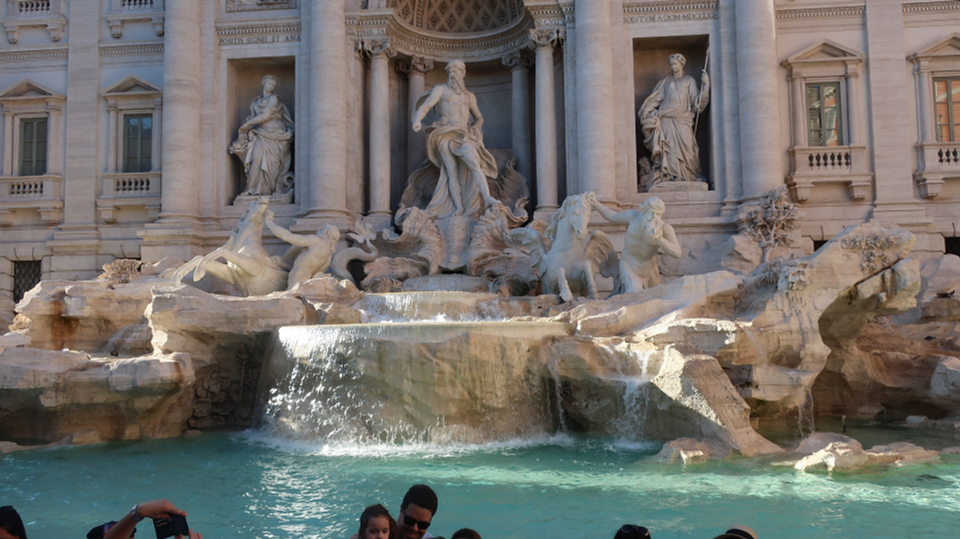
The Trevi Fountain (Fontana di Trevi)
The Trevi Fountain is one of Rome’s most famous landmarks, visited by nearly every traveler to the city.
The name Trevi is said to derive from the Latin word meaning “three-way junction,” referring to the three roads that converge in front of the fountain.
The legend that “throwing a coin over your shoulder into the fountain will ensure your return to Rome” is well known around the world.
The fountain’s completion, however, was anything but straightforward.
In the days of Imperial Rome, it was customary to build an elaborate fountain at the terminal point of an aqueduct that carried water from distant mountains.
The powerful streams of water cascading from magnificent fountains symbolized the honor and pride of the wealthy patrons who financed them, as well as of those involved in their construction.
The origins of the Trevi Fountain can be traced back to 19 BCE, to an aqueduct commissioned by Agrippa, the son-in-law and adopted son of Emperor Augustus.
This aqueduct carried water over a distance of 20 kilometers and was known as Aqua Virgo (“the Virgin Water”).
The earliest Trevi Fountain was a simple structure in which water flowed from a spout into three basins.
Like many fountains throughout Rome, it was destroyed during invasions by barbarian tribes.
From the 15th century onward, over a span of nearly 300 years, thirteen popes were involved in efforts to rebuild the fountain.
In the 18th century, under the orders of Pope Clement XII, the architect Nicola Salvi spent thirty years creating the fountain in its present form.
The result is a masterpiece of Baroque art, in which architecture, sculpture, and water are seamlessly unified.
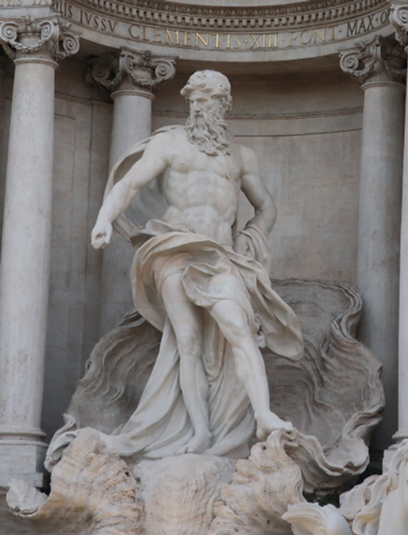
Set against the backdrop of the Palazzo Poli stand three imposing statues.
At the center is Poseidon, the god of the sea and earthquakes in Greek mythology (known as Neptune in Roman mythology).
One of the Twelve Olympian gods, he is second only to Zeus in strength.
He rules all the seas and supports even the continents themselves.
When enraged, he unleashes powerful earthquakes that violently shake the world.
As the guardian deity of springs, it is fitting that he stands at the center of the Trevi Fountain.
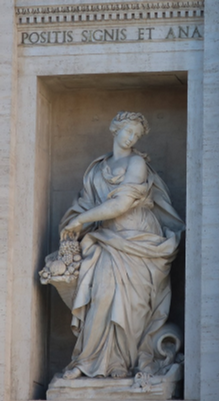
To Poseidon’s left stands Demeter, the Greek goddess of the earth, grain, and fertility (Ceres in Roman mythology).
Demeter is also known by the name Chloe, which originally meant “green.”
This is why Chloe came to be associated with the goddess of grain.
English words such as chlorophyll are derived from the same root.
From the Roman name Ceres, the English word cereal—meaning grain—was born.
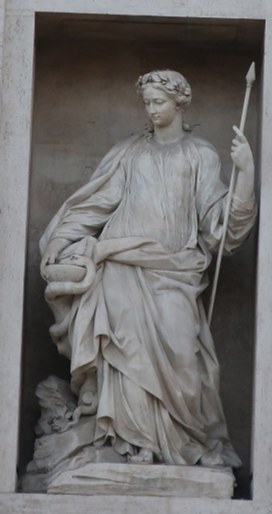
To Poseidon’s right stands Hygieia, the Greek goddess of health.
She is the daughter of Asclepius, the god of medicine, and is the caretaker of the sacred serpent, a symbol of medicine.
The “Cup of Hygieia” that she holds in her right hand is the universal symbol of pharmacy.
I have discussed Hygieia in detail in the October 1 issues of 2022 and 2024 (both in the Florence parts), and interested readers are encouraged to refer to those editions.
To be continued
コメントをお書きください