

Message from the Directorを更新しました(Jan 1,2025)。
Exploring the History of Medicine, Part 51: Florence, Part 31

December 1, 2025
The Mouth of Truth
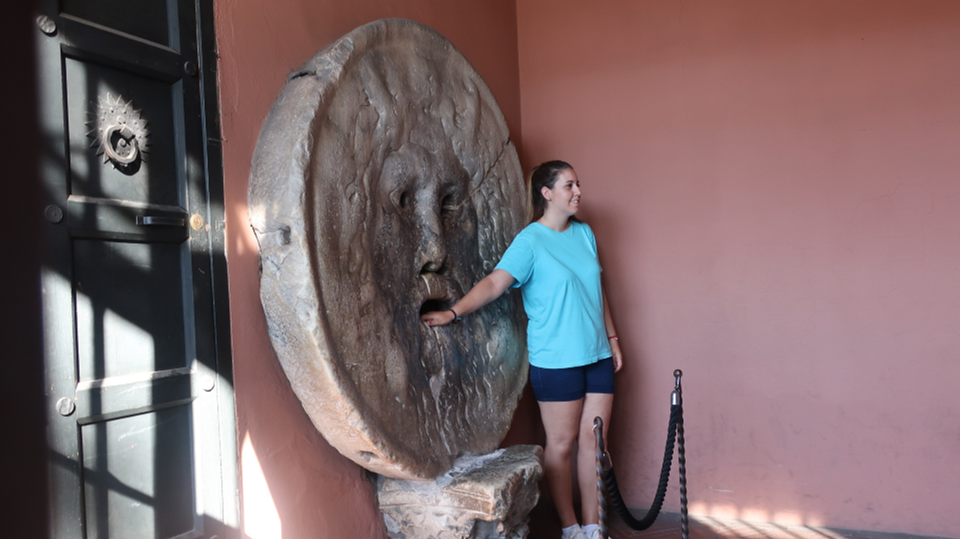
The famous “Mouth of Truth,” known for the legend that “a liar who puts a hand inside will have it bitten off,” is located at the Greek Orthodox church of Santa Maria in Cosmedin.
This church was built in the 6th century for the many Greeks who lived in the area.
When it was renovated in the 8th century, Greek residents decorated the building — hence the name Cosmedin.
In English we see the same root in words such as cosmetic, cosmetic surgery, and cosmetician.
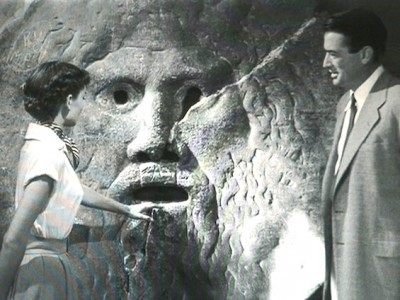
The iconic scene from Roman Holiday, where Gregory Peck pretends his hand has been bitten off to surprise Princess Ann, played by Audrey Hepburn, is known around the world.
The stone featuring the Mouth of Truth originally served as a manhole cover for an ancient Roman sewer.
Although the face looks like that of an old man with a thick beard, it is not human at all, but Pan, the rustic god from Greek mythology and the guardian deity of forests, fields, and livestock.
Pan was the child of Hermes, the messenger of the gods.
From birth he had a full beard, goat’s horns on his forehead, and goat’s hooves for legs.
His startled mother fled in fear, but Hermes carried the infant to Mount Olympus to show him to the other gods.
Amused and delighted by the baby’s odd appearance, they welcomed him joyfully.
Because he pleased all the gods, he was named Pan, the Greek word for “all.”
The prefix pan- appears in many words: panorama (a full view), pandemic (a widespread infectious outbreak), panperitonitis (generalized peritonitis), and pancytopenia (a reduction in all blood cell types).
As he grew into a rustic deity, Pan lived in caves, roamed the forests, and often hid in the bushes to ambush nymphs.
When he failed, he would retreat alone to indulge himself — earning a reputation as a thoroughly lascivious god.
Pan persistently pursued the nymph Echo, but when she rejected him, he robbed her of her ability to speak anything except repeated words.
This myth is the origin of the word echo, meaning “reverberation.”
The medical “echo” device we use today is likewise based on reflected sound.
Pan also bothered the nymph Syrinx, who fled and transformed herself into a reed along a riverbank.
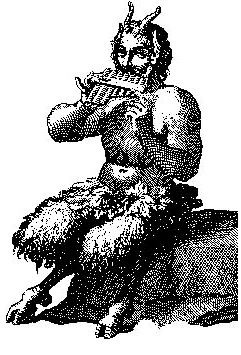
Heartbroken, Pan cut several reeds to make a flute, which he named the syrinx, and played a mournful tune.
In the illustration, Pan is shown playing this reed pipe.
From this story came the word syrinx for “tube,” which later gave rise to syringe, the English word for an injection needle.
Pan often napped in the shade of the forest.
When disturbed, he would roar with tremendous noise.
Startled cattle and sheep would scatter in confusion, and people too would panic and flee.
This is the origin of panic, the word for sudden fear or terror.
Today, the number of patients suffering from panic disorder — a type of anxiety disorder — continues to rise.
コメントをお書きください